> FORMULA STUDENT CHASSIS

I led the chassis team of the IP Paris Racing Team, the Formula Student team of Institut Polytechnique de Paris, which is designing an electric single-seater. The car is not built yet; I did most of the initial frame designs, working from the Formula SAE rules.

+47%torsional stiffness, 374 → 550 N·m/°
−1.6 kgframe mass, 48.0 → 46.4 kg
15 minper optimisation run
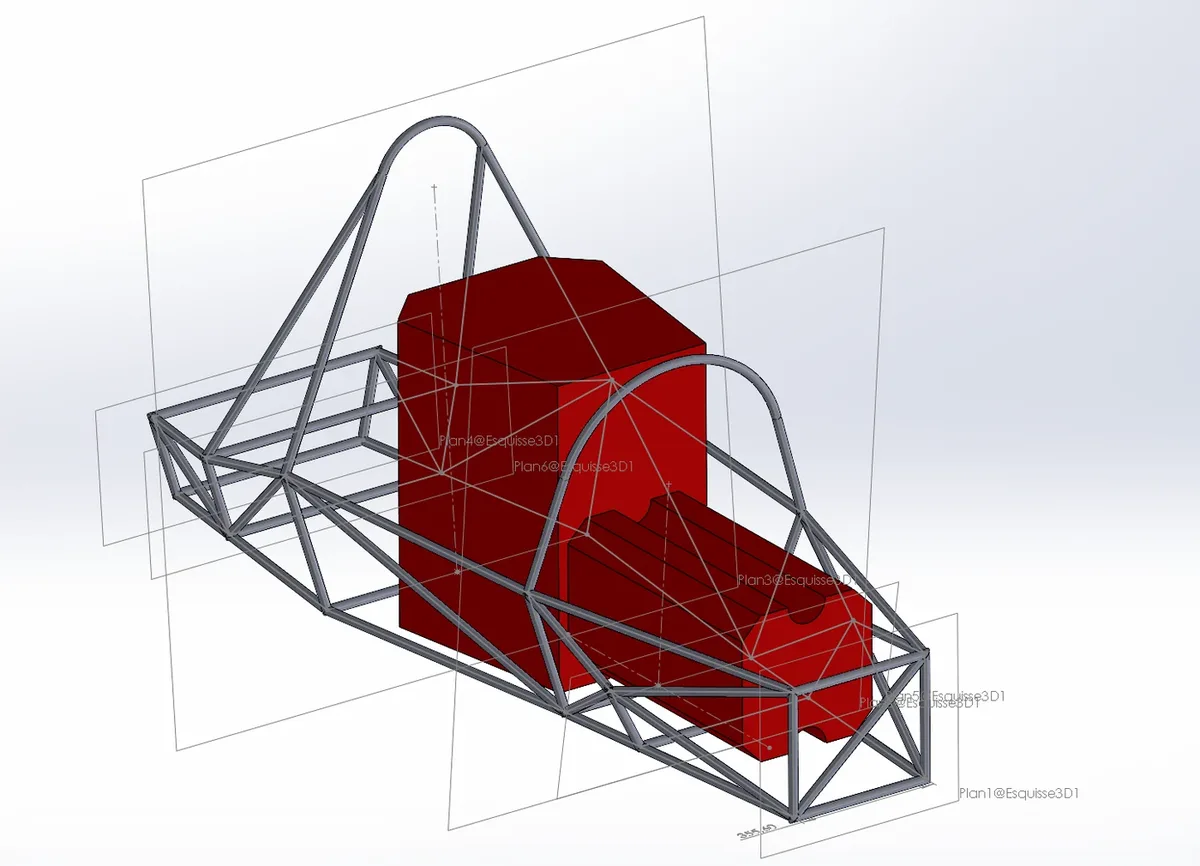
CAD of the tubular spaceframe with red keep-out volumes
A first frame and the volumes it must keep clear for the driver and components.

A spaceframe has to be stiff in torsion, light, and leave room for the driver and every component. Doing that by hand means one CAD iteration at a time. In a course project (MEC585) with a classmate, we tried to automate it: the frame is described by 13 numbers (lengths, angles, bulkhead sizes), each candidate is solved as a frame of Timoshenko beams in FEniCS under torsion, and an optimiser removes mass until the frame just meets the 550 N·m/° target.

The optimised frame gained 47% in stiffness and lost 1.6 kg. With one tube size and a single load case it is a method, not a frame ready for competition, but it is a quick way to compare layouts before detailed CAD.
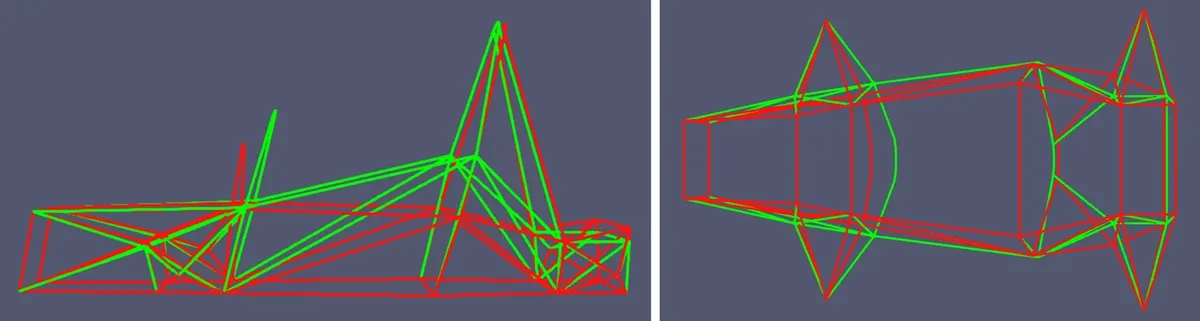
Initial and optimised frames overlaid in side and top views
Initial and optimised geometry, side and top views.
< prev: X-Rocket next: piezo harvester >